
When planning a new website, one of the most common questions is whether you need website design, website development or both. Although the terms are often used interchangeably, they describe different disciplines with distinct responsibilities. Understanding the relationship between them can help businesses set realistic expectations, communicate more effectively with specialists and invest in the right services.
The discussion around Website Design vs Website Development is not about deciding which discipline is more important. A successful website usually depends on both. Design focuses on the visual appearance, usability and user experience, while development transforms designs into a functioning website using code, frameworks and supporting technologies. Whether you are launching a small business site, an online shop or a complex web application, appreciating the difference between web design and web development can improve project outcomes.
Website Design vs Website Development: Understanding the Difference
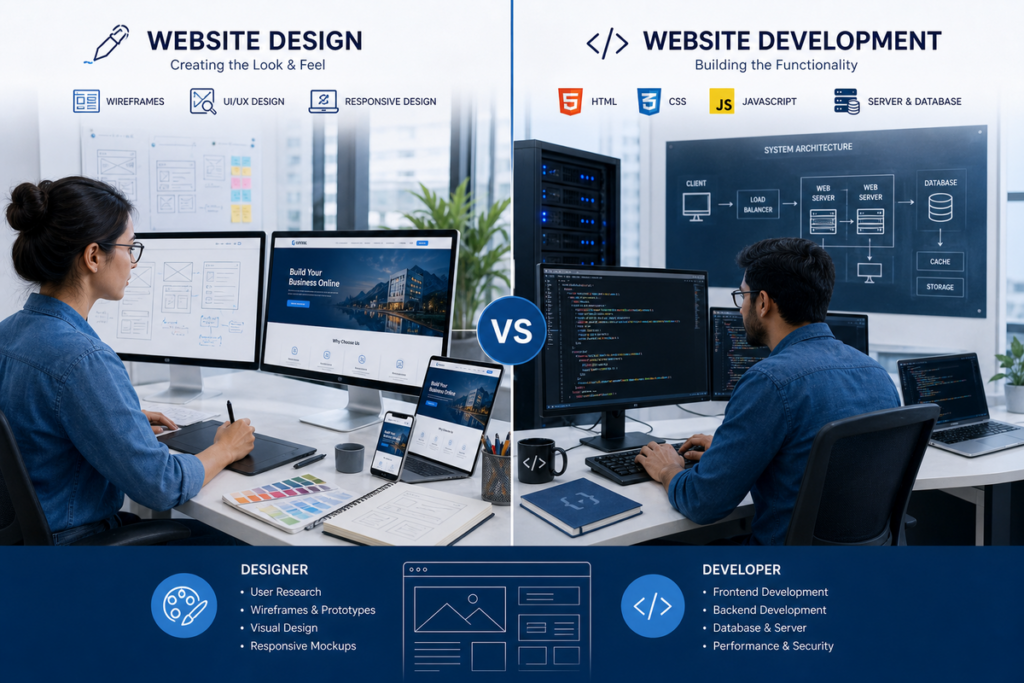
The simplest way to understand web design vs web development is to think of design as planning the experience and development as building the product. Designers decide how information should be presented, how visitors navigate pages and how branding is expressed. Developers implement those ideas by creating reliable, secure and responsive websites.
Website design generally centres on user experience, user interface, responsive layouts, accessibility and visual consistency. Website development concentrates on functionality, data handling, integrations, website performance and technical implementation.
Many organisations choose professional website development services because even an excellent design requires robust development to work correctly across browsers and devices. Likewise, technically impressive code cannot compensate for poor navigation or confusing layouts.
The difference between web design and web development becomes especially important during planning. Establishing responsibilities early helps avoid misunderstandings, improves collaboration and creates a smoother delivery process.
What Is Website Design?
Website design is the process of planning and creating the visual and interactive aspects of a website. Designers consider branding, typography, colour palettes, spacing, imagery and page structure while ensuring users can accomplish their goals with minimal friction.
Modern website design extends well beyond aesthetics. It includes understanding user behaviour, creating logical navigation and ensuring interfaces remain intuitive across desktop, tablet and mobile devices through responsive web design.
Designers commonly produce wireframes before creating higher fidelity mock-ups and prototyping interactive journeys. These stages allow stakeholders to review structure and functionality before development begins, reducing unnecessary revisions later.
Core Elements of Website Design
Strong UI design creates attractive and consistent interfaces that support business objectives without distracting users. UX design examines how people interact with pages, helping simplify journeys such as finding information, submitting enquiries or completing purchases.
Responsive layouts ensure content adapts to different screen sizes, while website accessibility aims to make digital experiences usable for as many people as reasonably possible. Accessibility considerations include readable typography, colour contrast, keyboard navigation and meaningful content structure.
Designers also think about content placement, calls to action and information hierarchy. These decisions influence how easily visitors understand a page and move towards desired actions.
For businesses seeking local expertise, projects may involve collaboration with specialists serving Leeds, where design discussions naturally feed into technical implementation.
What Is Website Development?
Website development involves building the functional website using programming languages, frameworks and supporting technologies. Developers convert approved designs into working pages while ensuring reliability, scalability and maintainability.
Core web technologies include HTML for page structure, CSS for presentation and JavaScript for interactive functionality. Depending on project complexity, developers may also work with databases, APIs, authentication systems, content management systems and cloud services.
Website development frequently includes technical SEO considerations, website performance improvements, security updates, structured data implementation and website maintenance after launch. These responsibilities continue throughout a website’s lifecycle rather than ending when the site goes live.
Businesses exploring implementation options can compare broader website development solutions according to project scope and long-term support requirements.
Front-End, Back-End and Full-Stack Development
Front-end development focuses on everything users interact with directly. Front-end developers transform approved designs into responsive interfaces using HTML, CSS and JavaScript while maintaining consistency across browsers and devices.
Back-end development manages the server-side functionality behind the scenes. This may include databases, user authentication, business logic, APIs and content processing. Visitors rarely see this work directly, but it enables websites to function correctly.
Full-stack development combines front-end development and back-end development skills. Full-stack developers understand the complete technical workflow, although larger projects often benefit from dedicated specialists.
Developers sometimes integrate external services or machine learning capabilities where appropriate. Documentation from projects such as the ONNX ecosystem can support interoperability discussions for suitable software applications, while implementation choices should always reflect genuine business requirements.
Teams working with organisations in Cardiff may adapt technical solutions according to business goals, existing systems and future scalability.
Key Differences at a Glance
| Website Design | Website Development |
|---|---|
| Focuses on appearance and user experience. | Focuses on functionality and implementation. |
| Creates wireframes, layouts and prototypes. | Builds working features using code. |
| Emphasises UI design and UX design. | Emphasises performance, security and integrations. |
| Plans responsive layouts. | Implements responsive behaviour across devices. |
| Works closely with branding and content. | Works with databases, servers and content management systems. |
| Defines interaction patterns. | Ensures those interactions function reliably. |
Although these distinctions are useful, real projects often involve collaboration rather than strict separation. Designers benefit from understanding technical constraints, while developers appreciate design principles that improve usability.
Businesses in Manchester or elsewhere frequently discover that integrated teams reduce communication delays and produce more consistent outcomes.
How Design and Development Work Together
The strongest digital projects begin with shared planning. Designers, developers, content creators and stakeholders establish objectives before visual work or coding starts. This collaborative approach helps align business goals with technical feasibility.
Wireframes define page structure before visual styling is applied. Prototyping then allows navigation flows and interactions to be reviewed. Once designs are approved, developers translate those concepts into accessible, responsive pages.
Technical decisions can influence design possibilities, while design choices may affect website performance. Early collaboration helps balance creativity with practical implementation.
Search visibility also benefits from cooperation. Developers may implement structured data based on the vocabulary provided by Schema.org, while designers ensure important content remains easy to discover and understand.
Technical SEO depends on both disciplines. Google’s documentation on crawlable links explains why accessible linking structures matter for search engines as well as users.
Projects supporting organisations in Hull often illustrate how coordinated planning reduces unnecessary redevelopment during later stages.
Which Service Does Your Business Need?
The answer depends on your current website and business objectives. If your existing site functions well but looks outdated or difficult to use, website design improvements may deliver significant value. If visitors experience broken functionality, poor loading speeds or limitations preventing growth, website development may deserve greater attention.
Many businesses require both disciplines. A redesign without updating outdated technical foundations can limit future flexibility. Equally, rebuilding software while ignoring usability may reduce customer satisfaction.
When evaluating website development services, consider long-term requirements such as maintenance, scalability, content management, accessibility, integrations and ongoing security updates rather than focusing solely on launch.
Google’s search appearance guidance provides useful information about how technical implementation and structured content can influence how pages are presented in search results.
Where cloud-backed functionality is appropriate, the official Firebase documentation offers implementation guidance for supported services.
Businesses based in Bristol may prioritise different combinations of design and development depending on whether they need a brochure website, ecommerce platform or bespoke application.
Organisations operating in Colchester sometimes begin with design workshops before progressing into phased development, allowing priorities to be refined over time.
Common Misconceptions
Design alone creates a successful website
Visual appeal matters, but functionality, accessibility, content quality and performance remain equally important. Attractive interfaces cannot compensate for unreliable technical implementation.
Development is only about writing code
Professional developers also think about maintainability, security, testing, scalability and long-term website maintenance. Good development supports future improvements as well as immediate functionality.
Responsive web design is only a design issue
Designers define responsive behaviour, but developers implement it. Achieving consistent experiences across devices requires cooperation.
Technical SEO replaces good content
Technical SEO improves discoverability, but it complements rather than replaces valuable, accurate content. Helpful information remains fundamental to successful websites.
Google’s guidance for representing your business online also reinforces the importance of accurate information when maintaining a digital presence.
Experience supporting businesses in Perth, Northampton, Blackpool, Ashford, Brighton, Eastbourne and London demonstrates that every organisation has different priorities, making careful discovery and planning more valuable than one-size-fits-all assumptions.
Frequently Asked Questions
Can one person handle both website design and website development?
Yes. Some professionals have full-stack development skills alongside design experience. However, larger or more specialised projects often benefit from dedicated designers and developers working together.
Which comes first, design or development?
In most projects, planning and design occur before development begins. Early prototypes help identify usability improvements before coding starts.
Is a content management system always necessary?
Not always. Many business websites benefit from a content management system because it simplifies updates, but the appropriate solution depends on project requirements and editorial workflows.
Why is accessibility important?
Website accessibility helps more people use your website effectively while also encouraging clearer structure and improved usability. Accessibility should be considered throughout both design and development rather than added at the end.
How important is ongoing website maintenance?
Website maintenance is an ongoing responsibility. Regular updates, monitoring, backups, security improvements and compatibility testing help keep websites reliable over time.
Conclusion
The comparison of Website Design vs Website Development is best understood as a partnership rather than a competition. Website design shapes the experience people have when visiting your site, while website development provides the technical foundation that allows those experiences to function reliably. Together they support usability, accessibility, performance and long-term growth.
If you are planning a new website or improving an existing one, begin by identifying your business goals and user needs. From there, determine whether design improvements, technical development or a combination of both will best support those objectives. A balanced approach typically delivers stronger results than focusing on only one discipline, creating websites that are attractive, functional and prepared for future change.