
Introduction
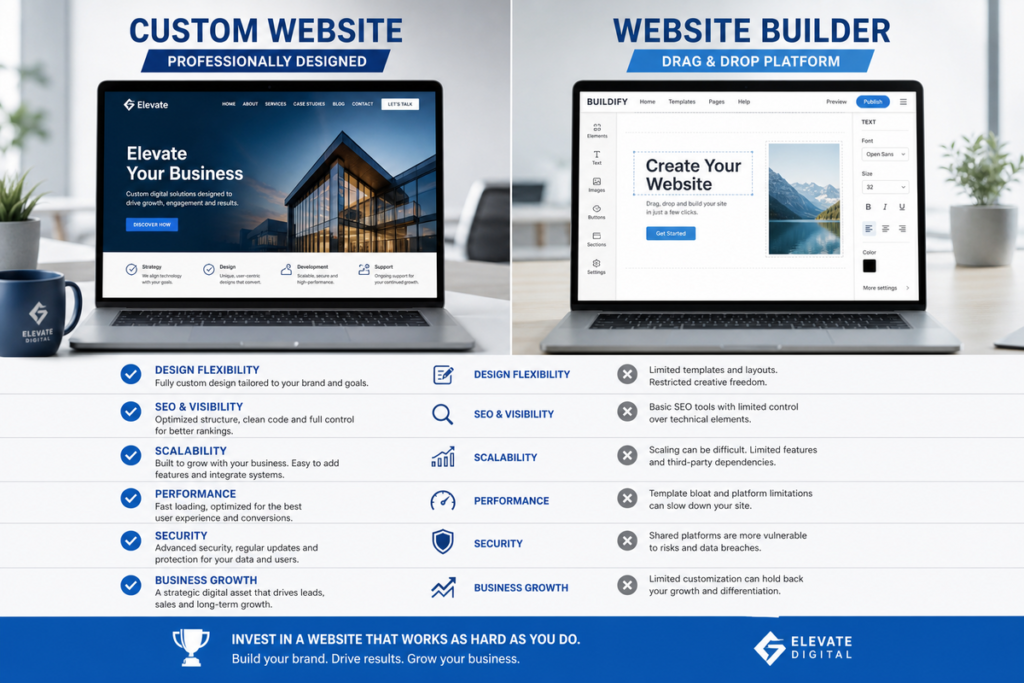
Choosing between a Custom Website vs Website Builder is one of the most important digital decisions a business can make. Your website influences how customers discover your brand, how easily they complete key actions and how well your online presence can grow over time. There is no universal answer because the right choice depends on your goals, budget, technical requirements and future plans.
A website builder offers an accessible way to launch a business website using ready-made templates and visual editing tools. A custom website is planned, designed and developed around specific requirements using professional website development practices. Both approaches can produce attractive websites, but they differ significantly in flexibility, ownership, scalability and long-term control.
This guide explains both options in practical terms, compares them across the areas that matter most and highlights situations where each approach is appropriate. If you are evaluating website development services, understanding these differences will help you make a more informed investment.
What is a website builder?
A website builder is a platform that enables users to create websites using visual tools rather than writing code. Many builders include hosting, templates, basic security features, a content management system, updates and support within a single subscription.
Modern no-code website builder platforms make it possible for small businesses, freelancers and start-ups to publish websites quickly. They often include drag-and-drop editing, responsive design templates, blogging tools, contact forms and ecommerce features.
The main benefit is simplicity. Users can focus on content instead of server configuration or custom web development. However, simplicity often comes with platform limitations. Advanced custom functionality, specialised workflows and complex API integrations may be restricted or require higher-tier plans.
Website builders are frequently suitable for brochure websites, portfolios, small online shops and organisations that need an online presence without extensive technical requirements.
What is a custom website?
A custom website is designed and developed specifically for the needs of a business rather than assembled primarily from standard templates. Professional developers can create unique layouts, optimise website performance, implement tailored business logic and integrate external systems where required.
Custom web design focuses on creating an experience that reflects a company’s brand while supporting business objectives. Depending on requirements, the project may use WordPress, another CMS or a fully bespoke application.
Professional website development also allows greater control over technical SEO, security practices, hosting environments, conversion optimisation and future enhancements. Businesses with evolving requirements often value the ability to expand functionality without being constrained by a builder’s ecosystem.
If you are planning long-term digital growth, exploring professional website development solutions can provide a clearer understanding of the available options.
Custom Website vs Website Builder: detailed comparison
Comparing a website builder vs custom website requires looking beyond the initial launch. The decision should consider ownership, flexibility and future business needs rather than only short-term costs.
| Area | Website Builder | Custom Website |
|---|---|---|
| Initial cost | Usually lower | Usually higher |
| Design flexibility | Template based | Highly tailored |
| Scalability | Platform dependent | Designed for future growth |
| SEO control | Good for many sites but platform limits may apply | Greater technical flexibility |
| Performance | Depends on platform | Can be extensively optimised |
| Integrations | Limited to supported apps | Wide range of API integrations |
| Ownership | Subject to platform terms | Greater control over code and infrastructure |
| Maintenance | Often managed by provider | Requires planned website maintenance |
Cost
Website builders generally reduce upfront expenditure because hosting, templates and updates are bundled together. A custom website often involves planning, design, development and testing costs. However, long-term value should include efficiency, flexibility and future development needs rather than launch costs alone.
Ownership and flexibility
Custom web development provides greater freedom over architecture, code and deployment choices. A website builder usually keeps businesses within its own ecosystem.
Website scalability
Businesses expecting expansion, multiple services or advanced workflows should consider website scalability from the beginning. Custom development generally provides broader opportunities for future enhancements.
SEO and technical optimisation
Both approaches can support SEO when implemented correctly. A custom website may provide greater control over technical SEO, structured implementation and performance improvements. Google’s guidance on indexing is available at https://developers.google.com/search/docs/indexing, while crawlable links are discussed at https://developers.google.com/search/docs/crawling-indexing/links-crawlable. Additional documentation is available at https://developers.google.com/search/docs/advanced.
Performance and user experience
Website performance influences user experience and Core Web Vitals. Custom implementations allow developers to optimise assets, loading behaviour and infrastructure. Website builders may perform well for many use cases, although optimisation options vary between platforms.
Security and maintenance
Most website builders include managed updates and hosting security. A custom website requires ongoing website maintenance, security monitoring and updates, but also provides greater control over implementation.
Integrations
Businesses needing CRM connections, inventory systems or bespoke workflows often benefit from custom functionality and API integrations. Website builders typically support integrations through approved applications, while custom development can connect with a broader range of systems.
Long-term value
The most cost-effective solution over several years depends on growth plans. Businesses with stable, straightforward requirements may find a website builder sufficient. Organisations expecting continual development often benefit from the flexibility of custom web development.
When a website builder is the better choice
A website builder may be appropriate when speed, simplicity and affordability are higher priorities than advanced flexibility.
- Launching a new business with limited resources.
- Creating a portfolio or brochure website.
- Managing content without technical expertise.
- Needing built-in hosting and maintenance.
- Running a small website with straightforward requirements.
These platforms can provide an efficient route online while reducing technical administration.
When a custom website is the better choice
A custom website is often preferable when digital operations support business growth or require specialised capabilities.
Examples include complex ecommerce requirements, membership platforms, bespoke customer journeys, advanced reporting, integrations with internal software and organisations where branding plays a significant strategic role.
Businesses operating in competitive markets may also value greater control over responsive design, conversion optimisation, performance improvements and future enhancements.
Location-specific professional services are available through pages including website development in Austin, website development in Charlotte, website development in San Francisco, website development in San Antonio, website development in Philadelphia, website development in Seattle, website development in Sacramento, website development in Raleigh, website development in Cleveland, website development in Minneapolis, website development in Knoxville, website development in Plano, website development in McKinney, website development in Boise, website development in Spokane and website development in New York City.
Common misconceptions
Website builders cannot rank in search engines
This is incorrect. Search visibility depends on many factors including content quality, technical implementation and competition. A builder can support SEO, although technical flexibility may differ from a custom solution.
Custom websites always require a bespoke CMS
Not necessarily. Many custom websites use WordPress or another content management system while adding tailored functionality.
Custom development means unlimited complexity
Although custom solutions allow greater flexibility, good projects remain focused on business objectives rather than unnecessary features.
How to choose the right option
Start by identifying business objectives rather than technology preferences. Consider expected growth, internal expertise, ongoing maintenance, required integrations, branding requirements and available budget.
If requirements are likely to evolve, discuss long-term planning with an experienced development team. Reviewing custom website development services can help clarify the scope of work and future possibilities.
Developers also rely on established resources when building and maintaining projects. Browser compatibility information is available through Can I Use, while version control practices commonly use Git documentation at https://git-scm.com/doc.
The best choice is the one that supports current needs while remaining practical for future growth. Neither option is inherently superior in every situation.
FAQ
Is a custom website better than a website builder?
Not always. A custom website offers greater flexibility and control, while a website builder can be an excellent choice for straightforward projects with limited budgets.
Can a website builder support SEO?
Yes. Many builders include SEO features. Success also depends on content quality, technical implementation and ongoing optimisation.
Can a custom website use WordPress?
Yes. WordPress can act as the CMS while the design and functionality are developed specifically for business requirements.
Which option offers better scalability?
Custom web development generally provides more opportunities for expansion because features and infrastructure can be designed around changing business needs.
Do custom websites require more maintenance?
In most cases, yes. Ongoing updates, monitoring and security practices should be planned as part of long-term website ownership.
Conclusion
The comparison between a Custom Website vs Website Builder is ultimately about choosing the solution that aligns with your business priorities. Website builders provide convenience, speed and lower initial costs, making them suitable for many smaller projects. Custom websites provide greater flexibility, ownership, scalability and technical control, making them a strong option for businesses with complex requirements or ambitious growth plans.
By evaluating your budget, technical needs, content strategy, SEO goals, security expectations and future development roadmap, you can make a decision that supports both present requirements and long-term success.